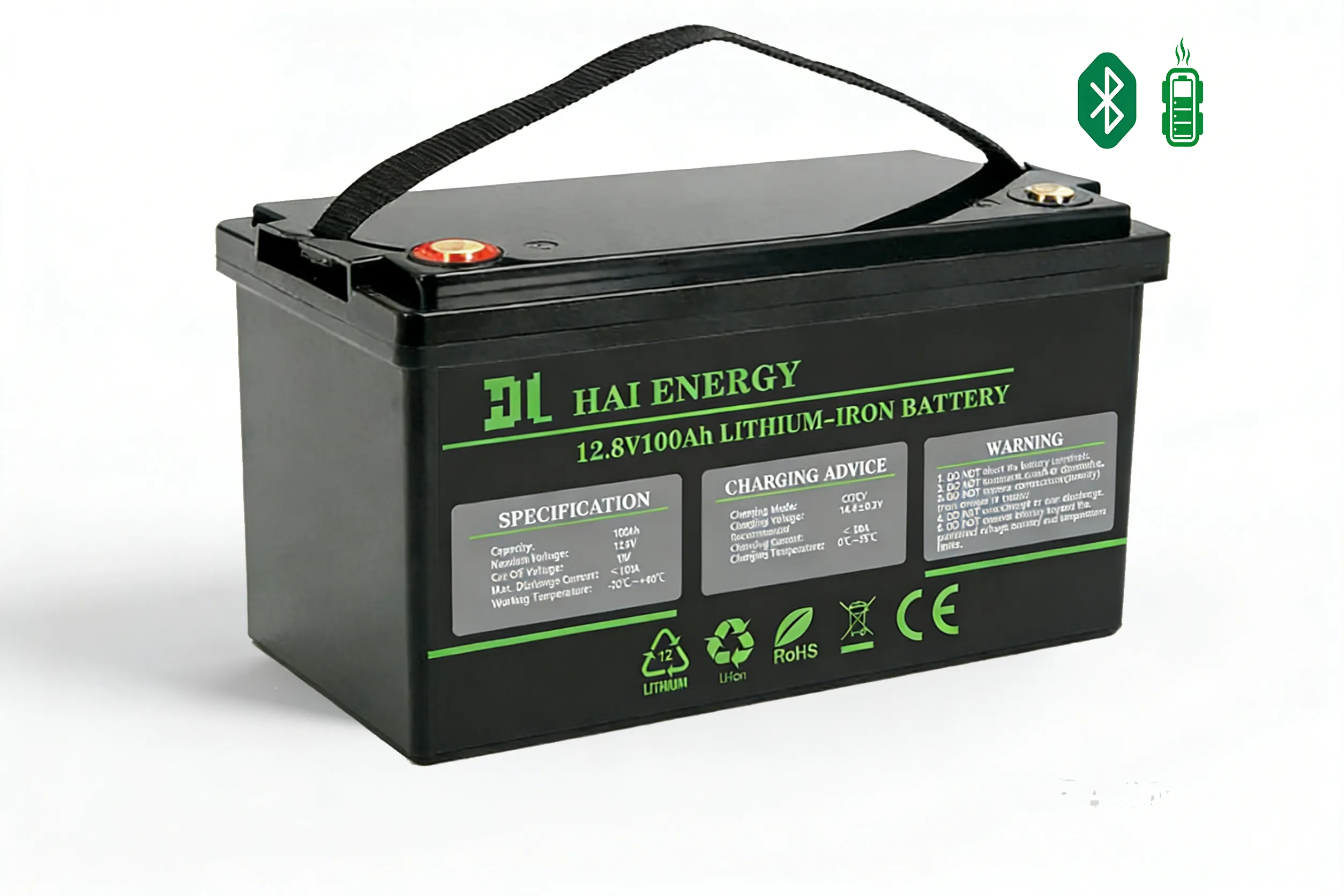
A 12V 100Ah LiFePO4 battery is the most common building block in the light-duty lithium market. It powers RV house systems, trolling motors, small solar arrays, off-grid cabins and 12 V backup installations. This guide explains what the label really means, how to size the pack for a specific load, and which lines on a specification sheet separate a dependable battery from a cheap one.
What “12V 100Ah” actually means
The 12 V figure is a nominal label. A LiFePO4 pack is built from four cells in series (4S), each with a nominal 3.2 V, which produces 12.8 V nominal and a full-charge voltage of about 14.4 V. Energy is simply nominal voltage multiplied by capacity. For a 12V 100Ah pack that is 1,280 Wh — the number you should use when sizing a system.
| Specification | Typical value, 12V 100Ah LiFePO4 |
|---|---|
| Nominal voltage | 12.8 V (4S × 3.2 V) |
| Nominal energy | 1,280 Wh |
| Charge voltage | 14.2 – 14.6 V, float at about 13.6 V |
| Continuous discharge current | 100 A with a 100 A BMS; higher with an uprated BMS |
| Usable depth of discharge | Up to 100 % (80 % recommended for the longest cycle life) |
| Typical weight | About 11 – 13 kg for a prismatic-cell pack |
LiFePO4 versus AGM and lead-acid at the same 100Ah label
Two batteries can both say “12 V 100 Ah” and still deliver very different amounts of energy. Lead-acid chemistry should not be discharged below about 50 % of its rated capacity without shortening its life, so a large part of the printed number is unusable. LiFePO4 can be discharged far deeper and recharged far more often.
| Property | 12V 100Ah LiFePO4 | 12V 100Ah AGM / lead-acid |
|---|---|---|
| Usable energy at 50 % DoD | 1,280 Wh (100 % DoD) | About 600 Wh |
| Cycle life | 3,500+ cycles | 300 – 500 cycles |
| Weight | About 11 – 13 kg | About 29 – 33 kg |
| Recharge time | 2 – 4 h at recommended current | 8 – 12 h, longer in the final stage |
| Maintenance | None; no topping up, no equalising | Regular water top-up on flooded types |
| Ventilation | Safe to install indoors | Requires venting of gases |
The practical result: one 12V 100Ah LiFePO4 pack replaces roughly two 12V 100Ah AGM batteries in usable capacity, at about a third of the weight. For a boat or an RV, that weight difference changes how the vehicle handles and how much fuel it burns.
How to size a 12V 100Ah battery for a real load
Sizing is arithmetic, not guesswork. List what you want to run, multiply watts by hours to get watt-hours, add them up, then divide by battery voltage to get amp-hours.
| Load | Typical draw | Hours per day | Wh per day |
|---|---|---|---|
| LED lighting (6 fixtures) | 30 W | 5 | 150 |
| 12 V fridge / cooler | 45 W average | 10 | 450 |
| Phone and laptop charging | 60 W | 2 | 120 |
| Water pump | 120 W | 0.5 | 60 |
| Ventilation fan | 25 W | 8 | 200 |
| Total | 980 Wh |
980 Wh per day fits inside a single 12V 100Ah pack (1,280 Wh) with a little headroom. Once you add a 1,000 W inverter for mains appliances, the calculation changes quickly, and a 24 V or 48 V system becomes the better choice. Two rules of thumb:
- Continuous loads above about 1,000 W: move up to 24 V or 48 V so the current stays manageable and the cabling stays thin.
- Trolling motors: a 12V 100Ah pack typically runs a 30 A trolling motor for roughly three hours at full throttle, and considerably longer at half throttle.
What to check on the specification sheet
Capacity and voltage are only the headline. These are the figures that decide whether the battery survives its warranty period:
- BMS continuous and peak current. A 100 A BMS suits most 12 V applications; inverters and winches can pull 200 A peaks, so confirm the peak rating and its duration.
- Cell format and grade. Prismatic LiFePO4 cells handle high continuous current better than small cylindrical cells at the same capacity.
- Low-temperature protection. Charging below 0 °C damages LiFePO4. A BMS with a charge cut-off, or a heated version, protects the pack in cold climates.
- Ingress protection. IP65 is the practical minimum for marine and outdoor enclosures; IP67 where immersion or washdown is expected.
- Communication. CAN, RS485 or a Bluetooth app lets you read cell voltages, temperature and state of charge instead of guessing.
- Terminal type and case dimensions. DIN sizes fit drop-in replacements; check the height before you order a rack or a locker.
Building 24V, 36V and 48V banks from 12V units
Series connection raises voltage, parallel connection raises capacity, and both are common in the field.
- 2S = 25.6 V, 3S = 38.4 V, 4S = 51.2 V nominal. Use the same model, the same batch and the same state of charge.
- Parallel packs must be balanced before connection — within 0.1 V — otherwise a large current flows between them the moment the terminals touch.
- Not every BMS supports series use. Ask the question before you buy, not after.
If the project is 48 V from the start, purpose-built 48 V units are simpler and safer than four 12 V batteries in series: see our 48V LiFePO4 energy storage batteries and the 48V 100Ah rack mount battery.
Charging a 12V 100Ah LiFePO4 battery correctly
LiFePO4 is not charged like lead-acid. Set the charger to a lithium profile, or set the voltages manually:
- Bulk and absorption: 14.2 – 14.6 V. Higher voltages shorten life for very little extra capacity.
- Float: 13.5 – 13.6 V.
- Never use an equalisation or desulphation cycle. Those modes are designed for lead-acid and will trip the BMS.
- Charge current: 0.2 C to 0.5 C (20 – 50 A for a 100 Ah pack) is a comfortable working range.
Where a 12V 100Ah LiFePO4 battery fits best
- RV and camper van house banks — lighting, fridge, pumps, chargers. See the 12.8V 100Ah DIN-size RV battery.
- Trolling motors and marine electronics — our trolling motor lithium batteries cover 12 V to 36 V.
- Small solar and off-grid systems — 1.28 kWh per pack, expandable in parallel.
- 12 V backup and mobility — where a sealed, fume-free battery can be installed indoors.
Buying wholesale: what to confirm with the factory
When you order in volume, the commercial terms matter as much as the technical ones. Confirm these points in writing before placing a purchase order:
- Minimum order quantity and price breaks for the capacity and BMS configuration you need.
- Cell grade and traceability — a datasheet for the cells, not just for the finished pack.
- Custom BMS settings for your inverter brand, including communication protocol and charge profile.
- Private label options — case colour, printed ratings, packaging and manual language.
- Documentation package for your market, and lead time from deposit to shipment.
We build 12 V to 48 V LiFePO4 packs to order at our own facility. To discuss a specification, send your load list or datasheet through the contact page and we will come back with a configuration and a quotation.
Frequently asked questions
How long will a 12V 100Ah LiFePO4 battery last?
Expect more than 3,500 charge cycles. Cycled once a day that is roughly ten years of service, though calendar ageing also matters: a pack stored at high temperature loses capacity faster than one kept cool and partially charged.
Can I use a 12V 100Ah LiFePO4 battery with a lead-acid charger?
Only if the charger can be set to a lithium or AGM profile at 14.2 – 14.6 V and the equalisation stage can be switched off. A charger that insists on 14.8 V absorption and 15 V equalisation will damage the pack.
Is 100Ah enough to run a 1,000W inverter?
Current, not capacity, is the limiting factor. A 1,000 W inverter draws about 90 A at 12 V, which is close to the limit of a 100 A BMS once inverter losses are added. Use a pack with a higher continuous rating, or move to 24 V where the same load draws about 45 A.
Do 12V 100Ah LiFePO4 batteries need maintenance?
No water topping up, no equalising and no terminal corrosion treatment. Check the torque on the terminals once a year and keep the pack between 20 % and 80 % state of charge if it will be stored for a long period.
Can I connect 12V 100Ah batteries in series for 48V?
Yes, if the BMS supports series connection, all packs are the same model and batch, and they are balanced to within 0.1 V before connection. For new 48 V projects a purpose-built 48 V battery is usually the cleaner solution.
Related products and resources
- 12V 100Ah LiFePO4 deep cycle battery — the model this guide is written around
- Deep cycle LiFePO4 batteries for RV and marine — browse the full range
- LiFePO4 vs lithium-ion: which chemistry is right for your project — further reading
- 48V 100Ah LiFePO4 batteries for solar energy storage — further reading
- How to size a battery bank for load shedding & off-grid backup — Further reading
- Lithium battery import compliance: UN38.3, CE and UL — Further reading
Need a custom capacity, a private label or an OEM/ODM programme? Request a wholesale quotation and we will reply with a configuration and pricing.